


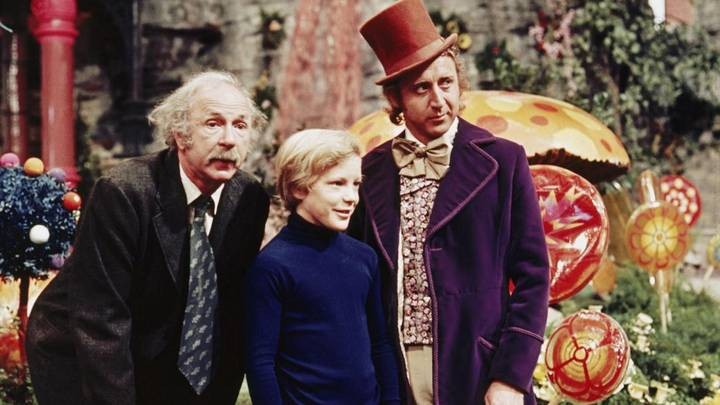
The first sort of lighthearted criticism of a Charlie and the Chocolate Factory character I came across was actually of Charlie Bucket, around ten years ago in a first year lit class. It was just dropped in the online forum by the tutor to stir some discussion. The idea was that Charlie was ‘selfish’ because when he found 50 pence on the street he didn’t take it straight home to his mother, but bought two chocolate bars first. I wrote a defence of my very old friend Charlie in response, pointing out that he was actually starving, that he refused to take anyone else’s meagre portion of food, no matter how hungry he was, and that he was planning on taking the change home to his mother, who would not have begrudged him. So I am going to suggest that it may have been in a first year lit class, somewhere, sometime, that the notion of Grandpa Joe as a villain was introduced by a tutor to engage students. Or maybe it just started on Reddit. I was surprised to learn about the Grandpa Joe Hate (GJH) itself, but the ‘Say No to Grandpa Joe’ website states that it has been running for almost two decades. The online GJH is mainly based on the Grandpa Joe’s character from the 1971 Willy Wonka & the Chocolate Factory (WWCF). And in the last couple of decades the online discourse has overtaken and is erasing the book canon. Presumably because it is fun. There’s nothing objectionable about Roald Dahl’s Grandpa Joe. But recent posts in the ‘grandpajoehate’ subreddit have dropped pictures of Grandpa Joe (played by Jack Albertson) posing with child sex offender, human trafficker and supervillain Jeffrey Epstein.
Before we go on, let’s talk about permissible hatred, something I usually apply to historical discourse, which takes place mostly in popular culture. Permissible spaces of hatred are created so groups or communities, and often the media, can give themselves free reign to use discriminatory and hateful language. In historiography this tends to rely on the status of the historical person being discussed. Seeing permissible hatred towards fictional characters in online discussion is interesting because it’s the fan groups that create the status of the figure. So, some time ago, someone came up with a joke about Grandpa Joe being an ‘asshole’, and over the years it has grown more hateful and more ridiculous in people’s attempts to elevate their status within the in-group by adding theories and discussion to the GJH. In the GJH we see not only ableism, but classism, and ageism directed towards four elderly, impoverished people in their mid-to-late-nineties. This is not ‘harmless fun’, because the stereotypes disseminated through this discourse of a fictional character have the ability cause harm in reality. The point is, of course, that people find this discourse allowable.
The way that the GJH overshadows the book canon also demonstrates that people really want to have these hateful discussions. By ignoring the book canon, in which all of Charlie’s grandparents cherish him, and he is especially close with Grandpa Joe, GJHaters believe that they are in permissible spaces to wreak discrimination on a character. After all, he does not exist in reality. The argument based on WWCF is that Grandpa Joe is selfish, manipulative, and irresponsible, that he exaggerates his frailty until Charlie finds a Golden Ticket, that he makes Charlie’s experience about himself, encourages Charlie to break Wonka’s rules, helps cause the Fizzy Lifting Drink incident, avoids taking responsibility for his mistakes, and ultimately escapes consequences for his actions.

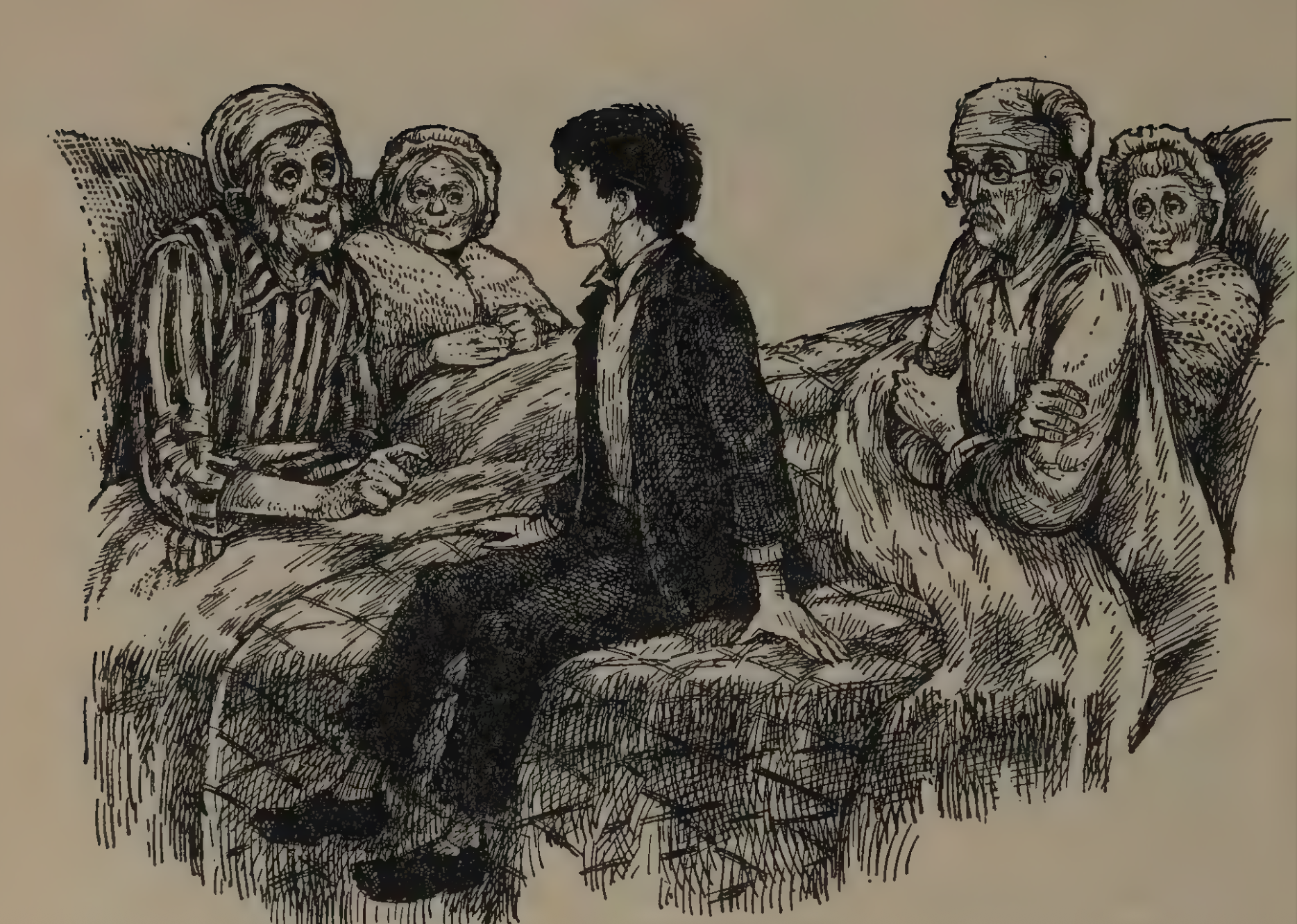
But the real focus of GJH is that a 96 year-old person fakes not being able to walk, is a burden on his family because he does not work (as if there are plentiful jobs for nonagenarians), and smokes tobacco. And because Grandpa Joe jumps out of bed for the ‘first time’ in twenty years upon learning about the Golden Ticket, it has been decided that he has been concealing the ability to walk. Now while WWCF did make so many changes from the book that it led to Roald Dahl disowning it, it never claims that any of Charlie’s four grandparents are unable to walk. A book reader might also wonder why I am bringing up ableism when none of the grandparents are described as having a disability. It is because ableism has already crept into the conversation, which is precisely the problem with permissible hatred. Popular discourse requires very little effort to become toxic, and colloquial language is often careless, normalising ridicule.
What may have started as a meme somewhere eventually morphed into genuinely bizarre takes, such as Decider’s description of Grandpa Joe as a ‘Lying Walker’. Much of the criticism is heavy with ageism. Commenters shriek, “Can you imagine the smell?” and ask why Grandpa Joe is not earning a steady income instead of “freeloading” on his grandson. Yet these complaints ignore a rather important detail: Grandpa Joe is in his nineties. The expectation that a nonagenarian living in desperate poverty should still be economically productive reflects a damaging capitalist attitude, one that measures human worth primarily in terms of labour and income. Somewhere along the line, a joke about Grandpa Joe stopped being a joke and became a vehicle for ageism, classism and ableism. The claim that Grandpa Joe disrespects his wife and is also a pervert because they share a bed with Grandpa George and Grandma Georgina is the absolute peak of this absurdity. At that point, criticism of the character has become so detached from the reality of the story that it collapses into self-parody.
The ludicrous Lying Walker label springs from the fact that Grandpa Joe, as Dahl describes it, has a burst of joy: this old fellow of ninety-six and a half, who hadn’t been out of bed these last twenty years, jumped on to the floor and started doing a dance of victory in his pyjamas. This is no way means that he is unable to walk; that conclusion rests on the age-old ‘benefits scrounger’ stereotype rather than anything Dahl actually wrote. It also reflects a persistent misconception about disability itself. The argument assumes that disability precludes ability: that a ‘genuinely disabled’ person must be permanently bedridden, passive, downtrodden, and incapable of moments of unexpected strength, mobility, or joy. Grandpa Joe’s brief dance of celebration is treated by critics as evidence of fraud, when it can just as easily be read as a fairy-tale moment in which excitement momentarily overcomes age, illness, and hardship.
Now, let’s take a look at how Dahl describes the living situation in the Bucket household:

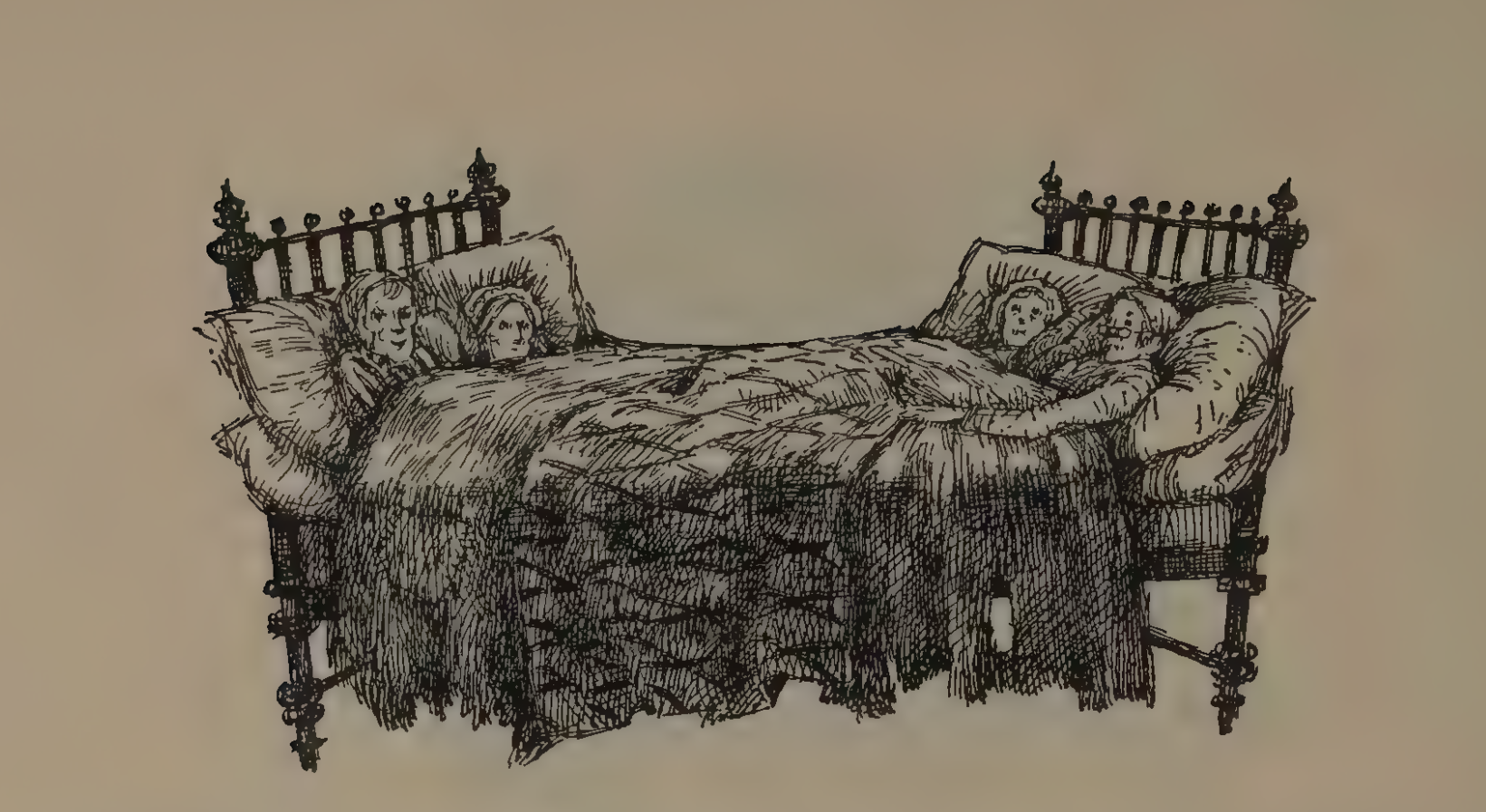
There were only two rooms in the place altogether, and there was only one bed. The bed was given to the four old grandparents because they were so old and tired. They were so tired, they never got out of it.
Grandpa Joe and Grandma Josephine on this side, Grandpa George and Grandma Georgina on this side.
Mr and Mrs Bucket and little Charlie Bucket slept in the other room, upon mattresses on the floor.
In the summertime, this wasn’t too bad, but in the winter, freezing cold draughts blew across the floor all night long, and it was awful.
There wasn’t any question of them being able to buy a better house – or even one more bed to sleep in. They were far too poor for that.
Mr Bucket was the only person in the family with a job. He worked in a toothpaste factory, where he sat all day long at a bench and screwed the little caps on to the tops of the tubes of toothpaste after the tubes had been filled. But a toothpaste cap-screwer is never paid very much money, and poor Mr Bucket, however hard he worked, and however fast he screwed was never able to make enough to buy one half of the things that so large a family needed. There wasn’t even enough money to buy proper food for them all. The only meals they could afford were bread and margarine for breakfast, boiled potatoes and cabbage for lunch, and cabbage soup for supper. Sundays were a bit better. They all looked forward to Sundays because then, although they had exactly the same, everyone was allowed a second helping.
The Buckets, of course, didn’t starve, but every one of them – the two old grandfathers, the two old grandmothers, Charlie’s father, Charlie’s mother, and especially little Charlie himself – went about from morning till night with a horrible empty feeling in their tummies.
Dahl obviously means that the grandparents spend most of their time in the family’s only bed and does not have to go into detail about mundane things such as using the toilet, washing, or moving around the house. The point is obvious. Yet because these details are not explicitly explained, some readers choose to fill the gaps with assumptions about laziness, deceit, or moral failure. In a society that increasingly requires everything to be over-explained, even in children’s literature, any ambiguity seems to demand an answer. Too often, the gaps are filled with casual assumptions about age, disability, and poverty rather than with an understanding of the story Dahl is actually telling.
Further to this, something still irks me about the way the family’s actual starvation continues to be glossed over in discussions of the story and in many adaptations. The Buckets are not merely poor or struggling; they are starving. After Mr. Bucket loses his job, breakfast is a single piece of bread, half a boiled potato for lunch, and dinner of watery cabbage soup. In the passages immediately preceding Charlie’s discovery of the fifty pence piece, Dahl describes the ten-year-old as suffering from malnutrition: Everything he did now, he did slowly and carefully, to prevent exhaustion.
Curiously, the 1971 film largely removes Mr Bucket from the story, making Mrs Bucket the family’s primary wage earner. Yet despite these changes, one complaint remains remarkably persistent: Grandpa Joe’s tobacco.
Let’s talk about classism.
In the film, Grandpa Joe smokes a pipe, a detail absent from Dahl’s novel. The decision was obviously a narrative convenience, giving Grandpa Joe something tangible to sacrifice to help Charlie accomplish his dream, as he saves the money to buy Charlie a bar of chocolate. Yet many critics seize upon the pipe as evidence of selfishness. The logic is familiar: if low-income groups can afford any small pleasure, then they cannot really be poor. A family may be hungry, cold, overcrowded, and living in desperate circumstances, but the moment an elderly man spends a few cents on a daily pipe, his poverty becomes suspect. Low-income groups are expected to account for every penny and justify every comfort. The irony is that Grandpa Joe is not really the subject of this discourse at all. A fictional ninety-six-year-old man from a children’s book has become a screen onto which people project anxieties about welfare, productivity, disability, ageing, and poverty. If Grandpa Joe is guilty of anything, it is of being old, poor, and dependent on his family. The accusations leveled against Grandpa Joe reveal a great deal about the discrimination in contemporary society. Old, poor, disabled? You’re a burden.
In the world of GJH, these disadvantages are transformed into evidence of moral failure. Grandpa Joe’s poverty becomes laziness, his age becomes a burden, his brief moment of physical exuberance becomes fraud, and his pipe becomes proof of selfishness.
What began as a harmless meme has evolved into a curious example of permissible prejudice, one that relies on ageist, ableist, and classist assumptions while claiming to be nothing more than a bit of fun. But the real villain of the story was never Grandpa Joe. It is the willingness to view elderly, disabled, and impoverished people through the lens of suspicion and contempt. Grandpa Joe is not the villain. You are.


